Saturday, March 30, 2019

Hold Star Cement; target of Rs 110: ICICI Direct


ICICI Direct's research report on Star Cement


We recently met the management of Star Cement. The key takeaways are: -i) Siliguri 2 MT grinding unit expansion is on track and is expected to be commissioned in H2FY20E. This plant will mainly serve the North Bengal and Eastern Bihar markets, which currently have annual demand of ~5.5-6 MT demand and are growing at healthy pace, ii) in the North East region, incremental demand will mainly be served by Dalmia and Star Cement as other players are already operating at higher utilisation, iii) currently cement prices in Guwahati are at around Rs 390/bag; limited scope for price increase because prices above Rs 415-420 levels, will attract supply from eastern region players, currently 10-12% of volumes come from these players, iv) due to supply shortage, prices of clinker in the north east region have shot up from Rs 3000 per tonne earlier to Rs4000-4500 per tonne, v) prices in West Bengal are facing headwinds due to incremental supply coming from the ramp-up of acquired plants of Century Textiles by UltraTech Cement.


Outlook


In the near term, cessation of transport subsidy, higher power cost and other expenses would keep margins under pressure. Hence, we maintain HOLD rating with a revised target price of Rs 110 (i.e. 8.5x FY20E EV/EBITDA).


For all recommendations report, click here


Disclaimer: The views and investment tips expressed by investment experts/broking houses/rating agencies on moneycontrol.com are their own, and not that of the website or its management. Moneycontrol.com advises users to check with certified experts before taking any investment decisions.

Read More First Published on Mar 22, 2019 03:17 pm

Tuesday, March 26, 2019

Here are the biggest analyst calls of the day: Domino's, Yum Brands, Booking Holdings, & more

Here are the biggest calls on Wall Street on Tuesday:

J.P. Morgan downgrading Yum Brands to 'neutral' from 'overweight'

J.P. Morgan believes the recent run-up in Yum shares leaves little upside to their estimates.

"While we do believe in YUM's long-term earnings algorithm of mid- to high-single-digit system-wide sales growth driven by ~4% unit growth and 2-3% worldwide comps, the 9% YTD run in the share price—and the corresponding multiple increase to 23.3x C20E P/E—leaves little upside to our estimates...":

J.P. Morgan upgrading Domino's Pizza to 'overweight' from 'neutral'

J.P. Morgan is bullish on Domino's sales growth.

"We believe DPZ's algorithm to achieve 8-12% system-wide sales growth remains intact... We are focused on its lowest-cost delivery platform and believe recent multiple compression to slower growing peers presents an opportunity...Our DPZ price target remains $270, or 25x C20E EPS, while our YUM price target is $94 or 21.7x C20E EPS with DPZ implying a 3.6% FCF yield at this multiple and YUM a 4.5% yield... We agree with company guidance that DPZ is an 8-12% system-wide sales growth company driven by 6-8% unit growth, 3-6% US comps, and 3-6% international comps... Dunkin', McDonalds, and Wendy's growth metrics are much lower, but DPZ offers the best comparison to YUM in our coverage today..."

Telsey downgrading Booking Holdings to 'market perform' from 'outperform'

Telsey believes Europe and growing competition provide challenges for Booking Holdings.

"With 4Q earnings season over, we have re-evaluated our outlook on the OTA sector and for BKNG in particular... We are lowering our PT to $1,800 and downgrading the stock to MP due to: (1) a weaker European economic outlook; and (2) growing threats from Airbnb and Google, which are now encroaching on BKNG's core hotel offering... While BKNG's valuation is not overly stretched, we believe these incremental challenges warrant a move to the sidelines..."

Argus downgrading Boeing to 'hold' from 'buy'

Argus is bullish long-term on Boeing but believes management needs to be more pro-active in its response to 737 Max groundings.

"We have been long-time bulls on the BA shares, raising our rating to BUY in May 2012, when the share price was $69... Since our upgrade, the shares have appreciated almost 540%, not including dividends... However, the shares have fallen almost 17% from their highs in the wake of the second fatal crash of a Boeing airplane.... We think the long-term outlook for Boeing is bright and are maintaining our five-year BUY rating... If the cause of the crashes turns out to be a mechanical or an engineering issue, Boeing can correct the problem and the industry, which is heavily dependent on the plane, the 737 Max jet, can move on...."

Read more about this here,

Sandler O'Neill & Partners downgrading MetLife to 'hold' from 'buy'

Sandler O'Neill believes management changes create uncertainty for MetLife.

"1) The company will have a new chief executive officer beginning with 1Q19 earnings... We believe this increases the possibility of execution risk after replacing a long-time, well-known executive at the company... 2) With a new CEO coming in along with the company increasingly talking about building up a sizeable asset management operation in recent years, we believe this increases the potential for an asset management acquisition the investment community does not greet with enthusiasm.... 3) We believe shares are currently appropriately valued trading at 7.7x 2020 and 92% book value ex-AOCI as compared to the peer group average of 7.6x and 124% considering we anticipate MET's operating ROE ex- AOCI in 2020 of 10.7% to be well below the peer group average of 14.6% and median of 12.8%... And especially so given our expectation for earnings to grow in 2019 vs. 2018 by 0.2%... 4) More specifically, we believe shares of PRU at 7.1x 2020 and 111% book value ex-AOCI with an operating ROE ex-AOCI of 13.7% are currently more attractively valued than MET..."

Saturday, March 23, 2019

Buy Axis Bank; target of Rs 825: ICICI Direct


ICICI Direct's research report on Axis Bank


Axis Bank's top management provided deep insights into the bank's strategy to achieve aspired RoE of 18% in the medium term (FY22E). New MD & CEO, Amitabh Chaudhary, showcased their Growth- Profitability- Sustainability (G-P-S) strategy. Drivers to lead to uptick in RoE are; 1) Risk normalisation (controlled asset quality and credit cost), 2) business mix optimisation (RAROC based portfolio choice), 3) operating efficiency (cost to asset ratio to trim below 2%). Our RoE estimates, without factoring in capital infusion, are at ~15.4% in FY21E. Hence, RoE target of 18% by FY22E, along with capital infusion, seems a bit difficult.


Outlook


We remain positive on the bank and upgrade our target price to Rs 825 (earlier Rs 790) valuing core bank at 2.6x FY21E ABV. We maintain BUY rating.


For all recommendations report, click here


Disclaimer: The views and investment tips expressed by investment experts/broking houses/rating agencies on moneycontrol.com are their own, and not that of the website or its management. Moneycontrol.com advises users to check with certified experts before taking any investment decisions.

Read More First Published on Mar 22, 2019 03:35 pm

Thursday, March 21, 2019

Life After Facebook: The Untold Story Of Billionaire Eduardo Saverin’s Highly Networked Venture Fi

&l;p&g;&l;sup class=&q;drop-cap color-accent font-accent&q;&g;W&l;/sup&g;&l;/p&g;&l;p&g;hen Eduardo Saverin greets entrepreneurs who come to visit him in his 8th-floor offices at the Singapore Land Tower, the 36-year-old knows he'll get asked &l;em&g;the question. &l;/em&g;The Facebook question. The cofounder of the social media giant is not only one of the world's youngest billionaires (net worth: $10 billion), but also something of a household name after his portrayal in the 2010 hit movie &l;em&g;The Social Network&l;/em&g;. A year later he renounced his American citizenship, &l;a href=&q;https://www.forbes.com/sites/briansolomon/2012/05/17/on-eve-of-facebook-ipo-eduardo-saverin-fires-back-at-critics-over-accusations-of-tax-dodging/#2d256fe3792c&q; target=&q;_blank&q; class=&q;color-accent&q;&g;reportedly&l;/a&g; avoiding some $700 million in U.S. taxes. &a;nbsp;He's always denied moving to Singapore for tax reasons and cringes at his Hollywood alter ego—he's more comfortable behind a spreadsheet than on the silver screen. But he rolls with it, all in the name of furthering what he wants the world to know about the Eduardo Saverin of 2019, the cofounder of B Capital, a rapidly expanding venture capital firm that's on the cusp of taking bigger swings. &l;/p&g;&l;fbs-ad position=&q;top&q;&g;&l;/fbs-ad&g;&l;p&g;"I'm incredibly open, because I understand where the curiosity comes from," Saverin says in his first one-on-one interview for an article in seven years. "I'm happy to have them learn from me than otherwise through movies."&l;/p&g;&l;p&g;Since launching B Capital in 2015, Saverin and his partner Raj Ganguly have been working on deploying their first $360 million technology fund (Saverin fronted an undisclosed part of it), guided by a twist on the traditional firm-building approach. Most venture capital firms start local, with a couple investments in companies in their backyards. Not B Capital, where 30 employees in California (San Francisco and Los Angeles), New York and Singapore pursued a multinational approach from the start. Also key: an alliance with Boston Consulting Group providing Saverin's portfolio companies access to the elite consultancy's brain trust and their clients. Now with several high-profile hires joining the firm, including a U.S.-based chairman and a new partner with Apple and Box credentials, Saverin and Ganguly are taking the wraps off their business, which has grown well beyond a billionaire's hobby. They are expected to soon raise a second, much larger, fund.&l;/p&g;&l;figure class=&q;image-embed embed-2&q;&g;&l;div&g;&l;img src=&q;https://specials-images.forbesimg.com/imageserve/5c8fcfdc31358e79cabede2c/960x0.jpg?fit=scale&q; alt=&q;Raj Ganguly&q; data-height=&q;1687&q; data-width=&q;3000&q;&g;&l;/div&g;&l;figcaption&g;&l;fbs-accordion&g;&l;p class=&q;color-body light-text&q;&g;A friend from Saverin&s;s Harvard days, Raj Ganguly cofounded B Capital with him in 2015.&l;small&g;David Yellen&l;/small&g;&l;/p&g;&l;/fbs-accordion&g;&l;/figcaption&g;&l;/figure&g;&l;p&g;"No matter how lucky or blessed I might be, I will never retire on a beach," says Saverin. "We are still so early into making the technologies that will impact the world."&l;/p&g;&l;p&g;&l;sup class=&q;drop-cap color-accent font-accent&q;&g;w&l;/sup&g;&l;/p&g;&l;p&g;hen Mark Zuckerberg celebrated his IPO by ringing the Nasdaq opening bell from Facebook's California offices &l;a href=&q;https://www.forbes.com/sites/connieguglielmo/2012/05/18/facebook-ipo-gets-chilly-greeting-on-a-cool-morning/#5f84bc263833&q; target=&q;_blank&q; class=&q;color-accent&q;&g;in May 2012&l;/a&g;, his cofounder Saverin was thousands of miles away and out of mind, save for a securities filing detailing that his 53 million shares were converting to common stock. No surprise there. Saverin's stint with the company had ended in 2005, mired in controversy and lawsuits over his reduced stake in the company. By 2009, Saverin had moved to Singapore, &l;a href=&q;https://www.forbes.com/sites/briansolomon/2012/05/11/eduardo-saverin-renounces-u-s-citizenship-ahead-of-mega-facebook-ipo/#65962ad51ff6&q; target=&q;_blank&q; class=&q;color-accent&q;&g;giving up his U.S. citizenship&l;/a&g;. His life seemed a cliché: Gossip sheets gushed about his &l;a href=&q;https://www.businessinsider.com/ex-pat-facebook-cofounder-eduardo-saverin-has-a-bentley-and-doesnt-know-how-to-spend-his-ipo-billions-2012-5&q; target=&q;_blank&q; class=&q;color-accent&q;&g;Bentley&l;/a&g;, a &l;a href=&q;https://www.dailymail.co.uk/news/article-2146991/Eduardo-Saverin-The-geek-learning-party-Facebook-billions.html&q; target=&q;_blank&q; class=&q;color-accent&q;&g;standing table&l;/a&g; at an elite night club and &l;a href=&q;https://nypost.com/2012/05/13/facebook-cofounder-living-large-in-singapore-as-he-stiffs-us-for-a-possible-600m-in-taxes/&q; target=&q;_blank&q; class=&q;color-accent&q;&g;legendary bar tabs&l;/a&g; that could reach &l;a href=&q;https://pagesix.com/2011/12/30/social-animal/&q; target=&q;_blank&q; class=&q;color-accent&q;&g;$50,000&l;/a&g;.&l;/p&g;&l;fbs-ad position=&q;topx&q;&g;&l;/fbs-ad&g;&l;p&g;Saverin tells a different story today. The son of Brazilian parents who relocated to Miami, Saverin was born in São Paulo but grew up affluent in south Florida, attending boarding school there before heading to Harvard, where he made his fateful connection to Zuckerberg while a junior studying economics. After his involvement with Facebook, Saverin dabbled at several startup projects before moving to Singapore for what was supposed to be a short stay to help a friend launch a business. He never left, he says now, because he fell in love with a local woman—whom he'd known briefly in his college days—and with the city itself. "Being a technology guy, it's an exciting place. It's a five-hour plane ride from a large part of the world's population." His decision to renounce U.S. citizenship the year before the IPO, he says, had more to do with setting up roots in Singapore than paying a lower tax rate on his wealth. "It was nothing related to the news at the time. That is not true," he says. That &l;a href=&q;https://www.wsj.com/articles/SB10001424052702303360504577410571011995562&q; target=&q;_blank&q; class=&q;color-accent&q;&g;reported $700 million&l;/a&g; was a speculative "back-of-the-envelope figure," says his spokesperson.&l;/p&g;&l;figure class=&q;image-embed embed-5&q;&g;&l;div&g;&l;img src=&q;https://specials-images.forbesimg.com/imageserve/5c8fd37531358e79cabede81/960x0.jpg?fit=scale&q; alt=&q;rule&q; data-height=&q;20&q; data-width=&q;900&q;&g;&l;/div&g;&l;figcaption&g;&l;fbs-accordion&g;&l;p class=&q;color-body light-text&q;&g;&l;/p&g;&l;/fbs-accordion&g;&l;/figcaption&g;&l;/figure&g;&l;figure class=&q;image-embed embed-17&q;&g;&l;div&g;&l;img src=&q;https://specials-images.forbesimg.com/imageserve/5c8feec231358e79cabee3cb/960x0.jpg?fit=scale&q; alt=&q;Facebook-founders&q; data-height=&q;1176&q; data-width=&q;1239&q;&g;&l;/div&g;&l;figcaption&g;&l;fbs-accordion&g;&l;p class=&q;color-body light-text&q;&g;&l;/p&g;&l;/fbs-accordion&g;&l;/figcaption&g;&l;/figure&g;&l;h2 class=&q;subhead-embed color-accent bg-base font-accent&q;&g;&l;strong&g;Facebook's First Friends&l;/strong&g;&l;/h2&g;&l;h3 class=&q;subhead3-embed color-body bg-base font-accent&q;&g;&l;strong&g;Fifteen years ago, five young Harvard students started a little social experiment on campus called The Facebook. It's now a $475 billion tech giant, but only Mark Zuckerberg is still at work there. &l;/strong&g;&l;/h3&g;&l;h2 class=&q;subhead-embed color-accent bg-base font-accent&q;&g;&l;strong&g;(1) Mark Zuckerberg,&l;/strong&g; 34 &l;/h2&g;&l;h3 class=&q;subhead3-embed color-body bg-base font-accent&q;&g;CEO of Facebook recently announced a plan to more closely integrate Facebook with two other apps it owns, WhatsApp and Instagram.&l;/h3&g;&l;h2 class=&q;subhead-embed color-accent bg-base font-accent&q;&g;&l;strong&g;(2) Dustin Moskovitz,&l;/strong&g; 34&l;/h2&g;&l;h3 class=&q;subhead3-embed color-body bg-base font-accent&q;&g;Zuckerberg&s;s former college roommate and currently cofounder and CEO of Asana, a work productivity software unicorn.&l;/h3&g;&l;h2 class=&q;subhead-embed color-accent bg-base font-accent&q;&g;&l;strong&g;(3) Eduardo Saverin,&l;/strong&g; 36&l;/h2&g;&l;h3 class=&q;subhead3-embed color-body bg-base font-accent&q;&g;Cofounder of B Capital, a venture capital firm.&l;/h3&g;&l;h2 class=&q;subhead-embed color-accent bg-base font-accent&q;&g;&l;strong&g;(4) Chris Hughes,&l;/strong&g; 35&l;/h2&g;&l;h3 class=&q;subhead3-embed color-body bg-base font-accent&q;&g;Worked as Facebook&s;s first spokesperson before buying &l;em&g;The New Republic&l;/em&g; magazine in 2012—selling it four years later—and writing a 2018 book on economic equality.&l;/h3&g;&l;h2 class=&q;subhead-embed color-accent bg-base font-accent&q;&g;&l;strong&g;(5) Andrew McCollum,&l;/strong&g; 35&l;/h2&g;&l;h3 class=&q;subhead3-embed color-body bg-base font-accent&q;&g;Designed Facebook's initial logo. Now CEO of a TV streaming startup, Philo, which raised $40 million in July 2018.&l;/h3&g;&l;figure class=&q;image-embed embed-6&q;&g;&l;div&g;&l;img src=&q;https://specials-images.forbesimg.com/imageserve/5c8fd38fa7ea43206f12834e/960x0.jpg?fit=scale&q; alt=&q;facebook-rule&q; data-height=&q;20&q; data-width=&q;900&q;&g;&l;/div&g;&l;figcaption&g;&l;fbs-accordion&g;&l;p class=&q;color-body light-text&q;&g;&l;/p&g;&l;/fbs-accordion&g;&l;/figcaption&g;&l;/figure&g;&l;p&g;And to hear Saverin talk about it, he's at peace with his Facebook past (and remains one of the biggest individual shareholders, with a 2% stake in the $475 billion company). Across two interviews, Saverin says the company is "incredibly close to my heart" and shares praise for Zuckerberg and COO Sheryl Sandberg's leadership. "I'm incredibly proud of what Mark has done, to build an institution of its size and value. He'll work hard to get things right," he says.&l;/p&g;&l;fbs-ad position=&q;topx&q;&g;&l;/fbs-ad&g;&l;p&g;Whether Saverin's serenity is the result of maturity or careful practice, it's unfaltering. As he speaks via Google Hangout in January, &l;em&g;Forbes &l;/em&g;asks if he's used a Facebook Portal, the video chat device the company launched in October to some criticism. Saverin bought one and hasn't opened it, but he's optimistic his son, now a toddler, will be one of Facebook's next billion members. "Today, hopefully he doesn't become a user at his age, he's too young. But hopefully it will preserve and be something then," he says.&l;/p&g;&l;p&g;In the years since he secured his once-in-a-lifetime stake—$2 billion at the time of IPO—he's embraced a new role as venture capitalist at B Capital, the firm he cofounded in 2015. While cofounder Ganguly oversees more of the day-to-day management, Saverin's on every investment call and oversees one key aspect of B Capital's strategy, its investments in Southeast Asia and India. Although he keeps a lower profile among Singapore's party set, now famous from &l;em&g;Crazy Rich Asians&l;/em&g;, access to Saverin is one key component of the B Capital pitch. "People come in expecting him to be a rock star," says Ganguly. &q;And he sits with the entrepreneur and starts asking about first-time delivery success rates."&l;/p&g;&l;figure class=&q;image-embed embed-18&q;&g;&l;div&g;&l;img src=&q;https://specials-images.forbesimg.com/imageserve/5c8ff4fb4bbe6f0d933bc72e/960x0.jpg?fit=scale&q; alt=&q;Bizongo&q; data-height=&q;1063&q; data-width=&q;1920&q;&g;&l;/div&g;&l;figcaption&g;&l;fbs-accordion&g;&l;p class=&q;color-body light-text&q;&g;&l;/p&g;&l;/fbs-accordion&g;&l;/figcaption&g;&l;/figure&g;&l;p&g;Ganguly's worked with Saverin since 2012, when the friends from their Harvard days—Ganguly got his business school degree there—reconnected in Singapore. Saverin was already writing smaller checks to startups, but with Ganguly, a former consultant and vice president at Bain Capital, he set out to raise formal funds from outside investors. Their first effort was Velos Partners, an $80 million private equity vehicle with a consumer bent they launched with several other friends. But by 2015, Ganguly and Saverin split off with a new idea to build a firm around two points of distinction: a strong footprint in Southeast Asia, an emerging market with less competition for deals, and as a matchmaker for one of the world's most prominent consulting firms, Boston Consulting Group. &l;/p&g;&l;p&g;Look at B Capital's portfolio today—it's made about 20 investments—and you'll see a pattern of international opportunism. Saverin and Ganguly have favored companies involved in commerce and logistics, specifically European, Indian and Asian companies that don't make it onto Silicon Valley's radar and where their knowledge of local complexity can help. &l;/p&g;&l;fbs-ad position=&q;topx&q;&g;&l;/fbs-ad&g;&l;p&g;One example: Ninja Van. A last-mile logistics provider for delivery services in Southeast Asia, the Singapore-based startup employs 2,000 people and works with 10,000 drivers. It's an expensive, complex business where B Capital stepped in to write a check when others balked. "Eduardo and the team asked the right questions," says Lai Chang Wen, CEO of Ninja Van. "They're able to give us a wider perspective across businesses and geographies." &l;/p&g;&l;figure class=&q;image-embed embed-21&q;&g;&l;div&g;&l;img src=&q;https://specials-images.forbesimg.com/imageserve/5c8ff588a7ea43206f128b8e/960x0.jpg?fit=scale&q; alt=&q;Desktop - MSWIPE&q; data-height=&q;1063&q; data-width=&q;1920&q;&g;&l;/div&g;&l;figcaption&g;&l;fbs-accordion&g;&l;p class=&q;color-body light-text&q;&g;&l;/p&g;&l;/fbs-accordion&g;&l;/figcaption&g;&l;/figure&g;&l;p&g;Then there are more traditional VC-backed companies in healthcare and business software where B Capital's U.S. team pitches its access to BCG. Armed with deep knowledge and executive connections, consulting firms have tried their hand at venture capital investing for years. But venture arms have traditionally been viewed as distractions from the consultancies' core businesses and usually are the first projects to get cut when the economy slows. Ganguly's and Saverin's big idea was to provide much of the benefit with no strings attached. BCG is a passive investor in B Capital, meaning they only call in the consultants when founders ask. "It's the cherry on top of the cake," says Sam Bodas, CEO of Bellevue, Washington-based Icertis, a contract management software maker that has signed at least three multimillion-dollar deals from connections made by senior partners at BCG.&l;/p&g;&l;p&g;Those ties impressed B Capital's newest partner, Karen Appleton Page. The former Box and Apple executive is joining B Capital in its San Francisco office, giving the firm seven partners. Of the early days of Box, where she was the eighth employee and ran business development, Page says: "At Box, we would have given our teeth for those connections to BCG."&l;/p&g;&l;fbs-ad position=&q;topx&q;&g;&l;/fbs-ad&g;&l;p&g;Giving B Capital even more street cred: Howard Morgan, the cofounder of First Round Capital, known for his early investments in Uber and Warby Parker, came out of retirement in 2017 to become chairman of the entire firm.&l;/p&g;&l;p&g;B Capital is growing fast. But it's too early to say if Saverin's second act is a success. The firm hasn't had any exits yet. Only about half a dozen of its investments carry significantly higher valuations than when B Capital invested, and it got into its best-known brand—scooter company Bird—relatively late. But Saverin and Ganguly are optimistic. With its first fund nearly fully committed, B Capital will go out to raise a second fund expected to be twice as large, sources tell &l;em&g;Forbes&l;/em&g;. B Capital declined to comment on its fundraising plans.&l;/p&g;&l;figure class=&q;image-embed embed-16&q;&g;&l;div&g;&l;img src=&q;https://specials-images.forbesimg.com/imageserve/5c8fe90d31358e79cabee1e1/960x0.jpg?fit=scale&q; alt=&q;Ninja Van&q; data-height=&q;1063&q; data-width=&q;1920&q;&g;&l;/div&g;&l;figcaption&g;&l;fbs-accordion&g;&l;p class=&q;color-body light-text&q;&g;&l;/p&g;&l;/fbs-accordion&g;&l;/figcaption&g;&l;/figure&g;&l;p&g;Founders who meet with Saverin and B Capital in 2019 can't be sure they're sitting down with a future Midas List-caliber tech investor or a billionaire dilettante. But as in his second act as venture capitalist, Saverin is uniquely positioned to guide entrepreneurs through the perils of success. Facebook famously implored its early employees to "move fast and break things." Fifteen years later, its estranged cofounder offers up a twist on the old motto for 2019: "Make mistakes all the time, but learn from it immediately," Saverin says. "Apologize if it affects anyone else. And make sure you don't make that mistake again."&l;/p&g;&l;p&g;&l;em&g;Cover photograph by Bryan van der Beek for Forbes&l;/em&g;&l;/p&g;&q;,&q;bodyAsDeltas&q;:&q;

Wednesday, March 20, 2019

Del Taco Restaurants Inc (TACO) Q4 2018 Earnings Conference Call Transcript

Logo of jester cap with thought bubble.

Image source: The Motley Fool.

Del Taco Restaurants Inc  (NASDAQ:TACO)Q4 2018 Earnings Conference CallMarch 18, 2019, 4:30 p.m. ET

Contents: Prepared Remarks Questions and Answers Call Participants Prepared Remarks:

Operator

Thank you for standing by, and welcome to the Fiscal Fourth Quarter 2018 Conference Call and Webcast for Del Taco Restaurants.

I'd now like to turn the call over to Mr. Raphael Gross to begin.

Raphael Gross -- Investor Relations Contact

Thank you, operator, and thank you all for joining us today. On the call with me are John Cappasola, President and Chief Executive Officer; and Steve Brake, Executive Vice President and Chief Financial Officer. After John and Steve deliver their prepared remarks, we will open the lines for your questions.

Before we begin, I would like to remind everyone that part of our discussion today will include some forward-looking statements. These statements are not guarantees of future performance and therefore, undue reliance should not be placed upon them. We do not undertake to update these forward-looking statements, at a later date and refer you to today's earnings press release and the SEC filings filed by Del Taco Restaurants Incorporated for a more detailed discussion of the risks that could impact future operating results and financial condition.

Today's earnings press release, also includes non-GAAP financial measures, such as adjusted net income, adjusted EBITDA, and restaurant contribution. Non-GAAP financial measures should not be considered as alternatives to GAAP measures, such as net income, operating income, net cash flows provided by operating activities, or any other GAAP measure of liquidity or financial performance. We refer you to today's earnings press release, which includes the reconciliations of these non-GAAP measures to the nearest GAAP measures.

I would now like to turn the call over to John Cappasola, Chief Executive Officer.

John D. Cappasola -- President and Chief Executive Officer

Thank you, Raphael. We appreciate everyone joining us for the quarterly call. Before walking through our Q4 results and plans for 2019, I wanted to briefly highlight some key financial and strategic takeaways from 2018, as I believe they will provide great context for what we hope to accomplish this year.

First, we achieved our sixth consecutive year of comparable restaurant sales growth across the Del Taco system, with a 2.5% increase. While our company operated restaurants generated a 1.5% increase. Franchise comparable restaurant sales grew at even faster rate of 3.8%, which we view as indicative of our strengthening franchise system and Del Taco's brand portability, across a diverse geographic footprint. In fact, franchise AUVs have increased approximately 30% in the last five years, across a 13 state footprint, with more than half of these restaurants, located outside of California. Our franchise momentum coupled with our non-core western-market refranchising strategy that I will discuss shortly, is expected to stimulate development interest, across existing and new franchisees to help expand Del Taco's brand reach.

Second, we hold our restaurant contribution margin steady at 19.7%, demonstrating our effective margin management strategy, despite only modest same-store sales growth at company restaurants. Fiscal 2018, was our fourth consecutive year achieving a restaurant contribution margin of approximately 20%. And we only recently achieved a $1.5 million AUV. Margin management has become a strong confidency to Del Taco and is critically important during this extended inflationary cycle.

Third, we opened 25 restaurants across the Del Taco system in 2018, including 13 company operated in 12 franchise restaurants. This compares to 20 openings in 2017 and only 13 in 2016. We are encouraged by the momentum we are seeing both in terms of more openings and the expanding geographic breadth of our openings, as 10 states had openings in 2018 and we expect openings in 14 states during 2019.

Our franchise acceleration has been particularly encouraging and has been enabled by strengthening our franchise foundation through enhancements and investments in recent years to position franchising as a pillar of our growth strategy. And fourth, we successfully rolled out elevated combined solutions. The latest iteration of our brand strategy to further our mission to be the leader in the value oriented QSR+ segment. It included brand catalysts and operational improvements, to elevate our brand positioning through a deeper focus on our fresh preparation, quality attributes and of course, hospitality. We also work to further strengthen our great culture with the launch of our new advertising campaign centered on real employees, highlighting our freshly prepared ingredients and QSR+ positioning by Celebrating the Hardest Working Hands in Fast Food.

Regarding Q4 itself, we extended our track record of comparable restaurant sales growth to 21 consecutive quarters to the Del Taco system, with a 1.9% increase and to 26 quarters, for a company operated restaurants with a 1% increase. Average check growth in company operated restaurants was 4.9%, including over 1% of menu mix growth, although transactions declined to 3.9%. Franchised comparable restaurant sales grew 3.2%, again outpacing company operated restaurants. We also increased our restaurant contribution margin by 40 basis points to 20.3%, and our adjusted EBITDA by $0.3 million to $23.6 million. Finally, we had 15 systemwide openings, consisting of seven company operated in eight franchised restaurants. Q4, marks the return of a fan favorite Premium Limited Time Offer, protein Shredded Beef, which has not been on the menu since 2012.

Shredded Beef included mid-tier and premium products to provide a great value and a quality food experience designed to elevate the brand. We paired that LTO with additional new product news, around epic burritos with the launch of the new Triple Meat Epic Burrito, featuring freshly grilled steak, chicken and bacon. These promotions help to drive over 1% of menu mix growth and a Q4 premium mix that exceeded 10%. Turning to our 2019 plans. We're focused on driving traffic momentum profitably, through a series of strategic initiatives using a phased approach. This starts with our digital transformation, through our new app and expanded third-party delivery, followed by enhancements to our core value program and delivering exciting new products, designed to generate incremental occasions.

Let me start with our digital transformation progress. Last November, we launched our new app as a key pillar of our CRM development strategy. Our initial focus is to provide offers to build our database, which is now eclipsed 400,000 registered users since November. We are encouraged by the early momentum of this marketing platform and a long term opportunity it provides us to drive guest frequency as it scales. We expanded our delivery initiative as well, during the first quarter by launching GrubHub delivery and substantially all company operated Del Toco locations. We believe a multiple DSP approach will optimize driver coverage to maximize consumer demand and we expect to launch both DoorDash and Postmates later this year.

While we continue to leverage the Buck & Change feature of Buck & Under to provide pricing flexibility, we are also enhancing our value platform, with the recent launch of Fresh Faves Boxes. Fresh Faves addresses growing consumer demand for abundant value and better positions us to meet value oriented guests needs. These are full meal deals, with two or three entrees, French fries and a drink, designed to deliver best-in-class, abundant value and variety that differentiates Del Toco from the competition. That differentiation really starts with our pricing approach by offering $4, $5 and $6 options, which provides the consumer great choice. The new Fresh Face Boxes will work in concert with Buck & Under and Buck & Change to offer expansive value, ranging from all the card items to bundled meal deals. Underpinning the launch of Fresh Faves Boxes, is our seasonal seafood promotion, featuring our popular Jumbo Shrimp, limited time offer and two Beer Battered Fish Tacos for just $4, made with hand-cut, sustainable, wild-caught Alaska Pollock in a crispy beer batter, it sounds delicious.

Finally, we plan to leverage innovation to drive incremental occasions with the launch of the Beyond Taco and Beyond Avocado Taco, during the second quarter. The growing guest demand for Vegan & Vegetarian options created an opportunity for us to partnered with Beyond Meat to be the first Mexican QSR chain to develop a proprietary blend of seasoned 100% plant based protein that taste similar to our current ground beef. We have tested Beyond Meat in selected restaurants in Greater LA, our entire San Diego market and more recently in all Oklahoma restaurants.

The response on social media and the results have been impressive. Increasing both check and traffic, as many new or lapsed users and regular Del Taco fans, visit our restaurants, eager to sample something innovative which delivers on the better for United States. We believe this program will drive sales, while further strengthening our QSR+ brand position.

Currently, our first quarter system wide comparable restaurant sales trends to-date, are running slightly negative and below our prior expectations, as expressed in mid-January. This outcome is influenced by the anticipated shift of lent, which began three weeks later this year and adversely impacts Q1, due to our very popular seasonal seafood promotion, as well as the unanticipated, extremely cold and wet weather we have experienced in California and throughout the West.

Looking forward, the expected combination of normalized weather and the favorable reversal of the Lent shift in the second quarter, is expected to sequentially improve same-store sales across our system, particularly our strategic initiatives kick-in and transaction compares ease.

Lastly, I wanted to reiterate our portfolio optimization strategy, which is designed to help grow AUVs, and stimulate new unit development. By shifting our portfolio mix to 55% franchised by summer 2020, our company operated footprint will predominantly reflect strong AUVs and restaurant margins in our core western-market, plus a strategic presence in our emerging markets. We expect this to also drive a sharpened operational focus and financial benefits, including improved company AUVS and restaurant margins, reductions in returning existing unit capital and reduced exposure to cost side inflation in California concentration.

In the first quarter, we acquired three high volume franchised restaurants and sold 13 lower volume units in the LA area to existing multi-unit Del Taco franchise groups. These transactions are expected to optimize these restaurants for AUV growth. And also we will consider buying or selling other restaurants in our core LA market, nothing further is planned at this time. We also plan to refranchise our core -- our non core Western-markets, to help stimulate development, as we begin to solve for the common prospective franchisee desire to buy, then build. We have no additional updates at this time other than to say that the process will proceed with a focus on transacting with the buyers who are most likely to deliver on their growth commitments. We remain confident they can all be refranchised by next summer 2020.

Over time, the net proceeds from such refranchising may help fund new companies seed markets, enabling co-development or adjacent franchise growth opportunities and other efficiencies.

In closing, there are a lot of exciting things happening at Del Taco. Our digital value and innovation strategies will serve as important catalysts for sales growth and as always, we plan to complement our top-line initiatives with effective margin management. And now Steve will review our Q4 financials and full year guidance for 2019.

Steven L. Brake -- Executive Vice President and Chief Financial Officer

Thank you, John. Total fourth quarter revenue rose 7.3% to $157.3 million from $146.5 million in the year ago fourth quarter, and included $4.1 million of franchise advertising contributions and $0.2 million of other franchise revenue related to the adoption of new revenue recognition rules in 2018. Excluding these revenue recognition impacts, total revenue grew by approximately 4.4%.

Systemwide comparable restaurant sales, increased 1.9% and lapped systemwide comparable restaurant sales of 2.4% during the fourth quarter of 2017, resulting in a two year comp of 4.3%. The Del Taco system is now generated 21 consecutive quarters of positive same-store sales. Fourth quarter company restaurant sales increased 4.4% to $146.7 million from $140.6 million in the year ago period. This increase was driven by contributions from additional company operated stores, as compared to the fourth quarter of last year, along with company operated comparable restaurant sales growth of 1%.

Fourth quarter company operated comparable restaurant sales growth, represents the 26th consecutive quarter of gains and was comprised of a 4.9% increase in check, including over 1% in positive menu mix, partially offset by a 3.9% decline in transactions. Franchise revenue increased 7% year-over-year to $5.3 million from $5.0 million last year. The increase was driven by a franchise, comparable restaurant sales growth of 3.2%, other franchise revenue related to the adoption of the new revenue recognition rules and additional franchise operating stores as compared to the fourth quarter of last year. Turning to our expense item's. Food and paper costs, as a percentage of company restaurant sales have decreased approximately 40 basis points year-over-year to 27.4% from 27.8%. This was driven by many price increases, partially offset by modest food inflation, including increased distribution costs. We also experienced slight margin pressure from our Shredded Beef and Epic Triple Meat promotions, which feature is slightly lower than typical margin percentage.

Labor and related expenses as a percentage of company restaurant sales decreased approximately 40 basis points to 31.6% from 32%. This was driven by lower payroll taxes due to the elimination of the federal unemployment payroll tax surcharge on California wages. That was retroactively eliminated in November of 2018 for the entire 2018 tax year. The favorable impact from this payroll tax elimination was 26 basis points for fiscal 2018, which was entirely realized during the fiscal fourth quarter.

We expect to retain this permanent lower rate prospectively. Occupancy and other operating expenses as a percentage of company restaurant sales increased by approximately 30 basis points to 20.6% from 20.3% last year. The 30 basis points of deleverage was due to inflationary pressure within this category that outpaced our modest same-store sales gain of 1%. Based on its performance, restaurant contribution was $29.8 million compared to $28.0 million in the prior year, an increase of 6.5%. Restaurant contribution margin increased approximately 40 basis points to 20.3% from 19.9%. General and administrative expenses were $13.4 million and as a percentage of total revenue increased by approximately 100 basis points year-over-year to 8.5%. This increase was driven by increased legal and related expenses, performance based management incentive compensation, stock based compensation expense, incremental SOX 404(b) compliance costs and the expense side of the other franchise revenue that is now reported on a gross basis, as well as lower than expected revenues which magnified the percentage.

Adjusted EBITDA increase 1.2% to $23.6 million from $23.3 million last year. As a percentage of total revenues, adjusted EBITDA decreased 90 basis points to 15% from 15.9% last year. Depreciation and amortization expense increased 9.6% to $8.2 million compared to $7.5 million last year, with the increase driven by the addition of new assets. As a percentage of total revenue, depreciation and amortization rose 10 basis points to 5.2%. Interest expense was $3.1 million compared to $2.4 million last year. The increase was due to an increased one month LIBOR rate and a higher average outstanding revolver balance compared to the fourth quarter of 2017. As of the end of the fourth quarter, we had $159 million outstanding under our revolver and our applicable margin for LIBOR loans remained at 1.75%.

The income tax expense was $2.1 million during the fourth quarter, for an effective tax rate of 27.1% as compared to a $24.8 million benefit during 2017, which included a one-time income tax benefit, as a result of the recent tax reform. Excluding this one-time benefit, the prior year rate would have been 41.6% and the lower effective tax rate is due to the impact of the recent tax reform. Net income for the fourth quarter was $5.6 million or $0.15 per diluted share compared to $35.2 million or $0.89 per diluted share last year.

In addition, we are reporting adjusted net income, which excludes impairment of long lived assets, restaurant closure charges and other income related to insurance proceeds. Adjusted net income in the quarter was $7.0 million or $0.18 per diluted share compared to $6.2 million or $0.16 per diluted share last year.

Turning now to our repurchase program, covering common stock and warrants. During the quarter, we repurchased 765,209 shares of common stock, at an average price of $11.05 per share and 20,596 warrants at an average price per warrant of a $1.93, for an aggregate of $8.5 million at fiscal year-end, approximately $29.6 million remained under the $75 million authorization.

I should add that during the fiscal first quarter of 2019, we have remain active when we repurchased approximately 200,000 shares in over 830,000 warrants, so far this year. One balance sheet point, is the presentation of the held for sale captioned in current assets to reflect the carrying value of property and equipment sold in connection with the 13 unit refranchised transaction during the first quarter, as well as, own property for three new restaurants open in 2018 that we expect the sale leaseback in 2019.

Two such sale leaseback transactions were finalized in the first quarter. The sale leaseback proceeds helped to net down our capital expenditures to align with our capital guidance that is provided on a net basis, whereas our GAAP presentation uses a gross basis. Before covering our fiscal year 2019 annual guidance, I want to discuss the new lease accounting standard that is effective at the start of fiscal 2019 and how it is expected to impact our balance sheet and P&L. Upon adoption, all existing build-to-suit leases will become operating leases and we will be recognized all the existing DoorDash assets and deemed landlord financing liabilities.

Going forward substantially all restaurants will be operating leases to be accounted for on the balance sheet. We expect to recognize operating lease liabilities of approximately $220 million to $240 million and right-of-use assets of approximately $210 million to $230 million. From a P&L perspective, there is no material change to our accounting for existing operating leases. However, the accounting for our prior build-to-suit leases will impact several key expense lines, primarily occupancy and other operating expenses or build-to-suit leases will now be reported.

The expenses for these leases were previously reported in depreciation and interest expense. This reclassification is expected to have an unfavorable impact of approximately 70 basis points on our restaurant contribution margin and adjusted EBITDA and has been incorporated into our annual guidance. It is important to note that this change is non-cash, expected to be net income neutral and does not reflect any underlying economic changes in performance.

In terms of guidance, we are reiterating what we issued in January, revised for the new lease accounting standard where appropriate and are furnishing several additional key metrics. Our top-line expectations are unchanged, including low-single digit systemwide, comparable restaurant sales growth with total revenue between $517 million and $527 million and company restaurants sales between $481 million and $491 million. We continue to expect menu pricing of up to 4%, to help mitigate the impact of food inflation of approximately 2% to 3% including higher distribution and transportation costs and labor inflation of approximately 6% primarily driven by $1 increase in California minimum wage.

General and administrative expenses between approximately 8.7% at 9% of total revenue. This range reflects a plateau compared to 2018 in light of our first quarter refranchising activity, which created an estimated 15 basis point increase, as the G&A savings from this transaction cannot be offset on a percentage basis, given the reduction in restaurant sales. With the aforementioned, new lease accounting rules, we revised our restaurant contribution margin expectations by 70 basis points to between 18.1% and 18.6%. We also revised our adjusted EBITDA estimate by the same of 70 basis points from the new lease accounting rules and we now expect between $66.5 million and $69.0 million.

The interes

Tuesday, March 19, 2019

Apple’s Streaming Venture Is a Distraction for Roku Stock

Although I’ve helped InvestorPlace readers successfully navigate Roku (NASDAQ:ROKU), I still find shares difficult to decipher. Less than a year-and-a-half has passed since the company’s initial public offering, yet the ROKU stock price traveled all over the map.

Apple’s Streaming Venture Is a Distraction for Roku StockApple’s Streaming Venture Is a Distraction for Roku StockSource: Shutterstock

The trailing six months provide a telling example of the volatility you can expect with the streaming-TV equipment provider. From an all-time record high in October last year to a devastating multi-year low less than 90 days later, ROKU stock at least keeps traders busy, and employed.

However, some analysts believe that the choppiness may soon fade. With Apple (NASDAQ:AAPL) probably on the verge of announcing its video-streaming service, it has added incentive to market Airplay 2. A proprietary system, Airplay facilitates audio or video streaming from an Apple product to a different device.

The second iteration of this technology expands this capacity to include several non-Apple brands, such as Samsung and Sony (NYSE:SNE). But Roku was left out in the cold. Of course, as a comparative minnow, losing such a high-profile partnership levered an exponential impact. Unsurprisingly, the ROKU stock price took it on the chin.

But with Apple needing to establish credibility in the content space, a partnership with ROKU makes sense. Recent rumors indicate that the two companies are on the verge of inking a deal. If so, Roku-armed T.V.’s can stream content via an iPhone, iPad or Mac computer, generating an instant value-add.

On the surface level, this is the type of fundamental driver that should sustainably and consistently drive the ROKU stock price. But after gaining 4% on the news, shares have more than given up that burst of profitability. How then should investors proceed?

Apple Streaming Is No Panacea for ROKU stock

In my last write-up about Roku, I had confidence that a strong showing for its fourth-quarter fiscal 2018 earnings report could spike shares. We got exactly that, and like clockwork, the streaming-equipment provider launched into low-earth orbit.

At the same time, I urged readers not to chase the ROKU stock price. Shares had already gone berserk prior to the Q4 report. After management disclosed their earnings beat, the company became even more of a unicorn. Year-to-date, the upstart streamer has skyrocketed over 137%.

Unfortunately, unicorns aren’t real. While the fundamentals support ROKU stock — the company’s user base has increased dramatically and productively — we’ve seen this before. I worry that the good news has been priced in. That means shares are rising based largely on emotion, such as the “fear of missing out,” or FOMO.

I’m going to stick with my last assessment: I encourage you to miss out, at least at this price point.


Compare Brokers

Primarily, I don’t see Apple’s streaming overtures as a panacea for Roku. For one thing, Android operating systems dominate mobile market share. Therefore, you’re talking about a necessarily limited market for Apple. From Roku’s perspective, they need to expand in total numbers, and not just with revenue-per-user.

Plus, Apple doesn’t really offer anything compelling or groundbreaking with its newfound original-content venture. Although it has aggressively courted executive, acting and directing talent to kickstart their entertainment enterprise, they’re way behind the curve.

Of course, Apple being Apple, they’re likely to throw their vast riches into the content and streaming space. But even then, I go back to my original concern about Roku: nothing new or exciting exists to justify the excess in the ROKU stock price.

As a result, I’d rather stay on the sidelines until a better opportunity arises.

Don’t Feed Your Emotions

If you take a look at Roku’s long-term chart, you’ll unmistakably recognize a pattern of sharp peaks and valleys. You don’t have to be a technical analyst — or even believe in the technical approach — to recognize that this is an emotional stock.

Specifically regarding Apple and the Airplay deal, Roku dropped nearly double digits on a single day when Apple apparently snubbed the streaming company. Later, it jumped significantly when AAPL relented, only to give up those gains 24 hours later.

Clearly, this isn’t about Airplay. Instead, most of the markets are reacting emotionally to any noteworthy news or even rumors. Don’t get me wrong: I think ROKU has serious upside potential. It just needs a reality check before it gets there.

As of this writing, Josh Eno

Saturday, March 16, 2019

Exelixis, Inc. (EXEL) CEO Michael Morrissey Sells 40,000 Shares

Exelixis, Inc. (NASDAQ:EXEL) CEO Michael Morrissey sold 40,000 shares of Exelixis stock in a transaction on Wednesday, March 13th. The stock was sold at an average price of $24.64, for a total value of $985,600.00. The transaction was disclosed in a filing with the Securities & Exchange Commission, which is available through the SEC website.
Michael Morrissey also recently made the following trade(s):

Get Exelixis alerts: On Wednesday, February 27th, Michael Morrissey sold 40,000 shares of Exelixis stock. The stock was sold at an average price of $22.69, for a total value of $907,600.00. On Thursday, February 14th, Michael Morrissey sold 40,000 shares of Exelixis stock. The stock was sold at an average price of $22.39, for a total value of $895,600.00. On Wednesday, January 30th, Michael Morrissey sold 40,000 shares of Exelixis stock. The stock was sold at an average price of $23.12, for a total value of $924,800.00. On Wednesday, January 16th, Michael Morrissey sold 40,000 shares of Exelixis stock. The stock was sold at an average price of $23.29, for a total value of $931,600.00. On Wednesday, January 2nd, Michael Morrissey sold 6,046 shares of Exelixis stock. The stock was sold at an average price of $20.00, for a total value of $120,920.00. On Friday, January 4th, Michael Morrissey sold 40,000 shares of Exelixis stock. The stock was sold at an average price of $20.11, for a total value of $804,400.00.

Shares of EXEL stock traded down $0.23 on Friday, reaching $24.53. The stock had a trading volume of 4,141,757 shares, compared to its average volume of 4,072,850. The company has a market cap of $7.45 billion, a P/E ratio of 17.15, a price-to-earnings-growth ratio of 0.77 and a beta of 2.22. Exelixis, Inc. has a 1 year low of $13.42 and a 1 year high of $25.19. The company has a debt-to-equity ratio of 0.01, a current ratio of 8.50 and a quick ratio of 8.41.

Exelixis (NASDAQ:EXEL) last released its quarterly earnings results on Tuesday, February 12th. The biotechnology company reported $0.37 earnings per share (EPS) for the quarter, topping the Zacks’ consensus estimate of $0.23 by $0.14. The firm had revenue of $228.60 million for the quarter, compared to the consensus estimate of $188.44 million. Exelixis had a return on equity of 48.90% and a net margin of 80.95%. The company’s revenue for the quarter was up 90.4% on a year-over-year basis. During the same period last year, the business posted $0.12 EPS. As a group, analysts expect that Exelixis, Inc. will post 1.04 earnings per share for the current year.

EXEL has been the subject of a number of research analyst reports. Oppenheimer set a $40.00 target price on Exelixis and gave the stock a “buy” rating in a report on Thursday, November 15th. ValuEngine raised Exelixis from a “strong sell” rating to a “sell” rating in a report on Saturday, December 1st. Piper Jaffray Companies restated an “overweight” rating and issued a $48.00 price target on shares of Exelixis in a research note on Friday, March 1st. Zacks Investment Research upgraded Exelixis from a “strong sell” rating to a “hold” rating in a research note on Monday, March 4th. Finally, BidaskClub upgraded Exelixis from a “hold” rating to a “buy” rating in a research note on Wednesday, January 9th. One analyst has rated the stock with a sell rating, five have given a hold rating and eight have issued a buy rating to the company. The company presently has a consensus rating of “Buy” and an average price target of $29.20.

Hedge funds and other institutional investors have recently added to or reduced their stakes in the stock. JOYN Advisors Inc. lifted its position in Exelixis by 334.2% during the fourth quarter. JOYN Advisors Inc. now owns 1,524 shares of the biotechnology company’s stock valued at $30,000 after purchasing an additional 1,173 shares in the last quarter. FTB Advisors Inc. lifted its position in Exelixis by 312.0% during the fourth quarter. FTB Advisors Inc. now owns 1,545 shares of the biotechnology company’s stock valued at $29,000 after purchasing an additional 1,170 shares in the last quarter. Cornerstone Advisors Inc. purchased a new position in Exelixis during the fourth quarter valued at $38,000. Financial Gravity Companies Inc. purchased a new position in Exelixis during the fourth quarter valued at $50,000. Finally, Laurel Wealth Advisors LLC purchased a new position in Exelixis during the fourth quarter valued at $59,000. Institutional investors own 75.68% of the company’s stock.

WARNING: This story was first published by Ticker Report and is the sole property of of Ticker Report. If you are viewing this story on another website, it was copied illegally and reposted in violation of US & international trademark and copyright legislation. The original version of this story can be accessed at https://www.tickerreport.com/banking-finance/4224651/exelixis-inc-exel-ceo-michael-morrissey-sells-40000-shares.html.

About Exelixis

Exelixis, Inc, an oncology-focused biotechnology company, focuses on the discovery, development, and commercialization of new medicines to treat cancers in the United States. The company's products include CABOMETYX tablets for the treatment of patients with advanced renal cell carcinoma who received prior anti-angiogenic therapy; and COMETRIQ capsules for the treatment of patients with progressive and metastatic medullary thyroid cancer.

Recommended Story: Net Margin

Insider Buying and Selling by Quarter for Exelixis (NASDAQ:EXEL)

Friday, March 15, 2019

Best Penny Stocks To Own For 2019

tags:JST,ADM,UFPT,RICK,

Each day, Benzinga takes a look back at a notable market-related moment that occurred on this date.

What Happened?

On this day 23 years ago, a judge ruled infamous penny stock pump-and-dumper Robert Brennan must pay $71.5 million in penalties and fines for securities fraud.

Where The Market Was

The Dow closed at 4,500.56. The S&P 500 traded at around 544.98. Today, the Dow is trading at 24,700.21 and the S&P 500 is trading at 2,762.59.

What Else Was Going On In The World?

In 1995, a domestic terrorist bombing attack on the Alfred P. Murrah Federal Building in Oklahoma City killed 168 people and injured another 680. After shocking the sports world by retiring to play professional baseball in 1993, NBA legend Michael Jordan returned to the Chicago Bulls. The average annual American income was $35,900.

Penny Stock Scammer Fined

Robert Brennan was the head of penny stock brokerage firm First Jersey Securities, which specialized in preying on ignorant investors and manipulating illiquid penny stock prices via pump-and-dump schemes. First Jersey television commercials featured Brennan standing next to a company helicopter and inviting unsuspecting investors to join in the fun.

Best Penny Stocks To Own For 2019: Jinpan International Limited(JST)

Advisors' Opinion:
  • [By Joseph Griffin]

    Warburg Research set a €47.00 ($55.95) price target on JOST Werke (ETR:JST) in a report published on Friday. The firm currently has a buy rating on the stock.

  • [By Logan Wallace]

    A number of firms have modified their ratings and price targets on shares of JOST Werke (ETR: JST) recently:

    5/25/2018 – JOST Werke was given a new €46.00 ($53.49) price target on by analysts at Deutsche Bank AG. They now have a “buy” rating on the stock. 5/25/2018 – JOST Werke was given a new €46.00 ($53.49) price target on by analysts at Deutsche Bank AG. They now have a “buy” rating on the stock. 5/25/2018 – JOST Werke was given a new €47.00 ($54.65) price target on by analysts at Warburg Research. They now have a “buy” rating on the stock. 5/24/2018 – JOST Werke was given a new €45.00 ($52.33) price target on by analysts at JPMorgan Chase & Co.. They now have a “neutral” rating on the stock. 5/8/2018 – JOST Werke was given a new €46.00 ($53.49) price target on by analysts at Deutsche Bank AG. They now have a “buy” rating on the stock. 4/4/2018 – JOST Werke was given a new €47.00 ($54.65) price target on by analysts at Warburg Research. They now have a “buy” rating on the stock.

    Shares of JOST Werke traded down €0.15 ($0.17), hitting €38.10 ($44.30), during mid-day trading on Friday, according to MarketBeat. 8,510 shares of the company’s stock were exchanged, compared to its average volume of 35,469. JOST Werke AG has a 52 week low of €27.20 ($31.63) and a 52 week high of €47.50 ($55.23).

  • [By Max Byerly]

    Hauck & Aufhaeuser set a €58.00 ($67.44) target price on JOST Werke (ETR:JST) in a report issued on Wednesday. The brokerage currently has a buy rating on the stock.

  • [By Joseph Griffin]

    JOST Werke AG (ETR:JST) has earned an average rating of “Buy” from the six research firms that are currently covering the company, MarketBeat reports. One analyst has rated the stock with a hold rating and five have issued a buy rating on the company. The average 12-month price target among analysts that have issued ratings on the stock in the last year is €49.33 ($57.36).

Best Penny Stocks To Own For 2019: Archer-Daniels-Midland Company(ADM)

Advisors' Opinion:
  • [By Max Byerly]

    PNC Financial Services Group Inc. boosted its holdings in Archer Daniels Midland Co (NYSE:ADM) by 0.6% during the 2nd quarter, according to the company in its most recent filing with the SEC. The institutional investor owned 230,910 shares of the company’s stock after acquiring an additional 1,287 shares during the quarter. PNC Financial Services Group Inc.’s holdings in Archer Daniels Midland were worth $10,581,000 at the end of the most recent quarter.

  • [By Stephan Byrd]

    Neuburgh Advisers LLC lowered its position in shares of Archer Daniels Midland Co (NYSE:ADM) by 38.6% during the second quarter, according to its most recent filing with the Securities & Exchange Commission. The fund owned 113,322 shares of the company’s stock after selling 71,390 shares during the period. Neuburgh Advisers LLC’s holdings in Archer Daniels Midland were worth $5,194,000 at the end of the most recent reporting period.

  • [By Motley Fool Transcribing]

    Archer Daniels Midland (NYSE:ADM) Q4 2018 Earnings Conference CallFeb. 5, 2019 9:00 a.m. ET

    Contents: Prepared Remarks Questions and Answers Call Participants Prepared Remarks:

    Operator

  • [By Shane Hupp]

    Amundi Pioneer Asset Management Inc. lowered its holdings in Archer Daniels Midland Co (NYSE:ADM) by 2.4% in the 1st quarter, according to its most recent Form 13F filing with the Securities & Exchange Commission. The institutional investor owned 1,109,443 shares of the company’s stock after selling 27,743 shares during the period. Amundi Pioneer Asset Management Inc. owned approximately 0.20% of Archer Daniels Midland worth $48,117,000 as of its most recent SEC filing.

Best Penny Stocks To Own For 2019: UFP Technologies Inc.(UFPT)

Advisors' Opinion:
  • [By Joseph Griffin]

    UFP Technologies (NASDAQ: UFPT) and China XD Plastics (NASDAQ:CXDC) are both small-cap industrial products companies, but which is the better business? We will contrast the two companies based on the strength of their dividends, valuation, analyst recommendations, institutional ownership, risk, profitability and earnings.

  • [By Logan Wallace]

    China XD Plastics (NASDAQ: CXDC) and UFP Technologies (NASDAQ:UFPT) are both small-cap basic materials companies, but which is the better stock? We will compare the two companies based on the strength of their profitability, analyst recommendations, dividends, institutional ownership, earnings, risk and valuation.

  • [By Ethan Ryder]

    Media coverage about UFP Technologies (NASDAQ:UFPT) has trended somewhat positive recently, Accern Sentiment Analysis reports. The research group identifies positive and negative press coverage by reviewing more than twenty million blog and news sources. Accern ranks coverage of publicly-traded companies on a scale of negative one to positive one, with scores closest to one being the most favorable. UFP Technologies earned a daily sentiment score of 0.03 on Accern’s scale. Accern also assigned headlines about the industrial products company an impact score of 47.0533500754779 out of 100, meaning that recent press coverage is somewhat unlikely to have an impact on the company’s share price in the near future.

Best Penny Stocks To Own For 2019: Rick's Cabaret International Inc.(RICK)

Advisors' Opinion:
  • [By Joseph Griffin]

    RCI Hospitality (NASDAQ:RICK) was upgraded by research analysts at BidaskClub from a “buy” rating to a “strong-buy” rating in a research note issued to investors on Friday.

  • [By Ethan Ryder]

    These are some of the news articles that may have impacted Accern Sentiment Analysis’s scoring:

    Get RadNet alerts: Edited Transcript of RDNT earnings conference call or presentation 9-Aug-18 2:30pm GMT (finance.yahoo.com) Stocks Favored By Analysts: RadNet, Inc. (NASDAQ:RDNT) & RCI Hospitality Holdings, Inc. (NASDAQ:RICK) (baycityobserver.com) RadNet, Inc. (RDNT) stock closes -0.37% above from its SMA-50 (nasdaqplace.com) $241.29 Million in Sales Expected for RadNet Inc. (RDNT) This Quarter (americanbankingnews.com) Zacks: Analysts Expect RadNet Inc. (RDNT) to Announce $0.15 EPS (americanbankingnews.com)

    Shares of RDNT traded up $0.20 during trading hours on Friday, hitting $14.10. The stock had a trading volume of 128,336 shares, compared to its average volume of 171,176. The company has a debt-to-equity ratio of 4.49, a current ratio of 1.06 and a quick ratio of 1.06. The company has a market cap of $678.40 million, a PE ratio of 48.62, a P/E/G ratio of 5.02 and a beta of 0.32. RadNet has a 1-year low of $9.50 and a 1-year high of $15.50.

  • [By Logan Wallace]

    Get a free copy of the Zacks research report on RCI Hospitality (RICK)

    For more information about research offerings from Zacks Investment Research, visit Zacks.com

Thursday, March 14, 2019

Why the dollar could keep rising this year even if the Fed doesn't hike

The U.S. dollar could build on its strong gains this year, even with the Federal Reserve not raising rates, as the United States' economic prospects near term look far less grim than those of other countries.

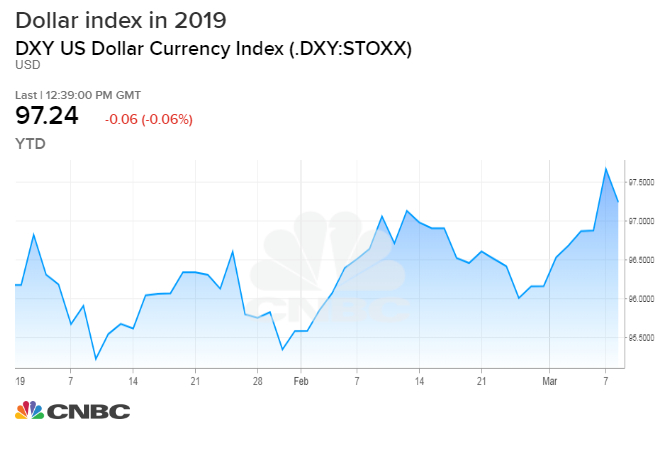
The dollar index, which tracks the greenback's performance against a basket of six currencies, is up more than 1 percent in 2019. Last week, it reached its highest level since Feb. 15. Against the euro, the dollar is up 2 percent this year and notched its biggest weekly gain in six months on Friday.

The dollar's rise defies the consensus from earlier in the year that the U.S. currency would go down as the Federal Reserve signaled fewer rate hikes moving forward. New tame inflation data on Tuesday supported the Fed's new tact.

"The dollar has stayed bid on the back of safe-haven demand," said Peter Ng, senior FX trader at Silicon Valley Bank. "The global slowdown is affecting everyone and at the current moment, it doesn't seem like there are any good replacements for the dollar."

Investors across the globe and asset classes are fretting over the possibility of a slowdown in economic growth amid weakening data.

Chinese exports dropped 20.7 percent in February from the year-earlier period, handedly missing expectations.

In the U.S., jobs creation came to an almost screeching halt in February as only 20,000 jobs were added. Economists polled by Refinitv expected the U.S. economy to have added 180,000 jobs last month. Some experts, however, attributed some of the hiring weakness to factors like weather and lingering effects from the government shutdown.

Over in Europe, the European Central Bank slashed its euro zone growth forecast for 2019 to 1.1 percent from 1.7 percent. ECB President Mario Draghi also said Thursday there is a "sizable moderation in economic expansion that will extend into the current year."

But despite the broad slowdown in economic data, U.S. growth remains solid compared to other countries. The U.S. economy grew by 2.6 percent in the fourth quarter of 2018. Meanwhile, the Institute for Supply Management said Tuesday its nonmanufacturing activity index rose 3 points to 59.7 in February.

The relative economic strength in the U.S. versus the rest of the world also has traders chasing the dollar because of comparatively higher interest rates. The 2-year Treasury note yield traded at 2.47 percent on Monday. Germany's 2-year sovereign paper, meanwhile, yielded negative 0.54 percent. Japan's 2-year note yield was also in negative territory. In other words, it is currently more profitable to own U.S. dollars versus most major currencies.

"If you compare the rates across the board, the U.S. still far outperforms," Silicon Valley Bank's Ng said.

Fed Chair Jerome Powell told CBS' "60 Minutes" he thinks the U.S. economy is still strong, but noted there is a chance that overseas weakness could start hitting the U.S.

Federal Reserve Board Chairman Jerome Powell speaks during a news conference on December 19, 2018 in Washington, DC. The US Federal Reserve raised the short-term interest rates by a quarter percentage point on Wednesday, the fourth increase of the year, and signaled two more hikes could come in 2019. Mark Wilson | Getty Images Federal Reserve Board Chairman Jerome Powell speaks during a news conference on December 19, 2018 in Washington, DC. The US Federal Reserve raised the short-term interest rates by a quarter percentage point on Wednesday, the fourth increase of the year, and signaled two more hikes could come in 2019.
Still, "financial conditions remain supportive and this may support growth going forward," said Mark Schofield, global head of macro product at Citi, in a note. "The interplay between markets and the real economy is delicate and unstable at the moment. The Fed will be aware of this."

There are risks to having a stronger dollar, especially for U.S. multinationals. A stronger dollar makes it harder for consumers and companies overseas to buy U.S. products by making them more expensive.

President Donald Trump said March 2 he was not pleased with the dollar's run-up this year, stating: "I want a dollar that's great for our country but not a dollar that's prohibitive for us to be doing business with other countries."

The U.S. trade deficit surged to a 10-year high in December, reaching $59.8 billion. The widening was driven by a 2.1 percent increase in imports and a 1.9 percent decline in exports.

"The trade trend defies President Trump's pledge to reduce America's reliance on imported goods, and he angrily shook his rhetorical fist at Fed Chairman Powell, blaming him for the strong US dollar. The President's economic dot connections are correct," Jack Ablin, founding partner of Cresset Wealth, said in a note to clients. "Dollar strength encourages imports while inhibiting exports by making US dollar-based goods and services less competitive. ... This means that unless the dollar reverses course and weakens quickly, America's trade deficit will likely worsen."

Subscribe to CNBC on YouTube.

Wednesday, March 13, 2019

5 Top Stock Trades for Tuesday: Apple, Nvidia, Boeing

The stock market went ripping higher on Monday, with the bulls hoping they set the tone for a strong week to come. What do our top stock trades of the day have to say?

Top Stock Trades for Tomorrow #1: Nvidia

top stock trades for NVDAtop stock trades for NVDA

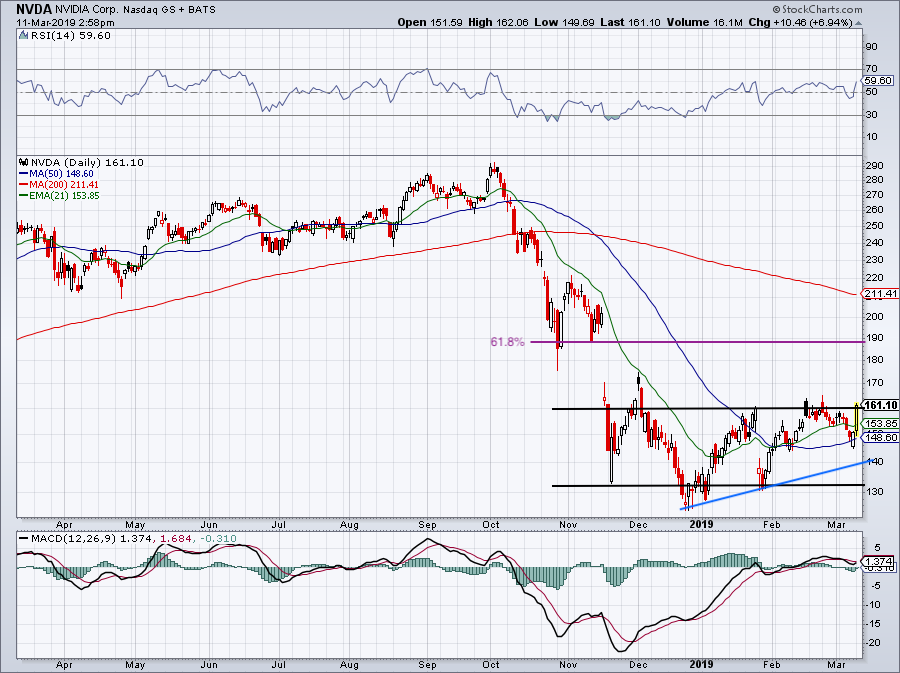
We just talked about this one last week, cautiously noting that Nvidia (NASDAQ:NVDA) shares were trending higher but risked falling back to its range lows near $130. In that same layout we said range resistance was near $160.

Who would’ve known that Nvidia would rally north of 7% after outbidding Intel (NASDAQ:INTC) on Mellanox Technologies (NASDAQ:MLNX) for $6.9 billion? With the rally NVDA is up over $160, but it’s not out of the woods yet. We’ve seen the stock stall out a few times just above this level. If we can get some continuation on Tuesday (up over $165) or just a few days of chop/drifting higher and staying over $160, it could setup for a larger rally.

If Nvidia begins to rally, it’s got the 61.8% Fibonacci retracement of the 52-week range at $188, while the gap fill up near $198. That would be a solid target if Nvidia can get some momentum.


Compare Brokers
Top Stock Trades for Tomorrow #2: Apple

top stock trades for AAPLtop stock trades for AAPL

Not all that long ago, we pointed out the very tight consolidation pattern Apple (NASDAQ:AAPL) was holding in. It flirted with several breakouts over the $175 to $176 level, but never really got going. Then on Friday, it gave us a false breakdown, opening below the 21-day moving average and short-term uptrend support.

It closed higher on the day, but not without giving us a fright first. That’s why the close is Oh. So. Important. Then we got our 3.3% rally on Monday. I would love to see this name fill the gap back up to $185 and touch its 200-day at $189, then digest.


Compare Brokers
Top Stock Trades for Tomorrow #3: Coca-Cola

top stock trades for KOtop stock trades for KO

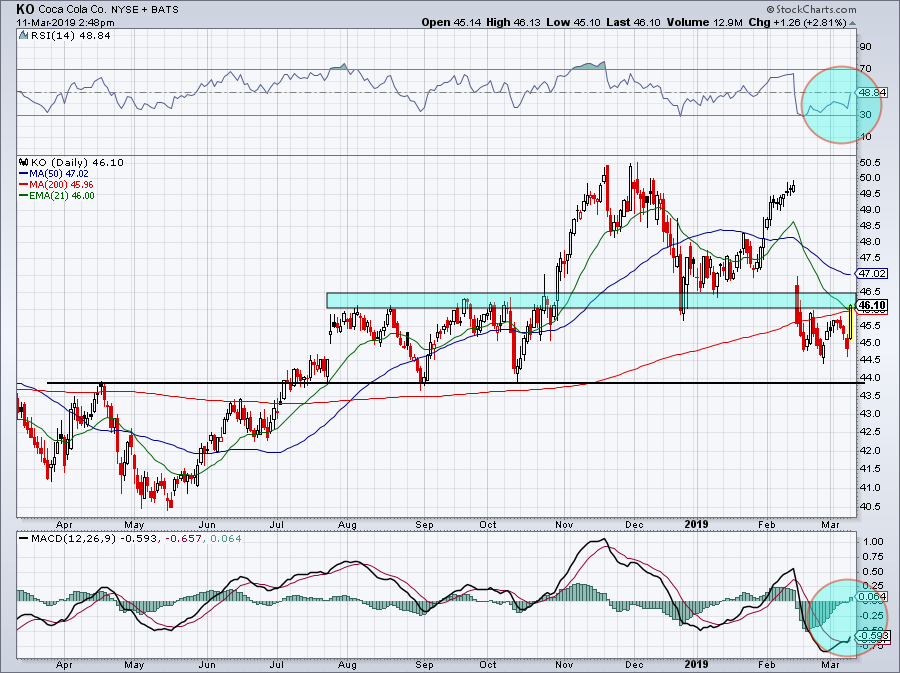
Rallying almost 3% on the day, Coca-Cola (NYSE:KO) bulls are happy to see some positive momentum. The move is thrusting KO back over the 200-day and 21-day moving average.

My concern would be a strong/neutral open on Tuesday that goes south as the day wears on, as sellers line up and dump on KO into possible resistance. Over $46.50 though and I feel that KO is making a stronger bullish move. The MACD and RSI (blue circles) still have a lot of room to run if this name can gather some momentum.

If resistance kicks it down, look for support down near $43.90 to $44.50.


Compare Brokers
Top Stock Trades for Tomorrow #4: InVitae

top stock trades for NVTAtop stock trades for NVTA

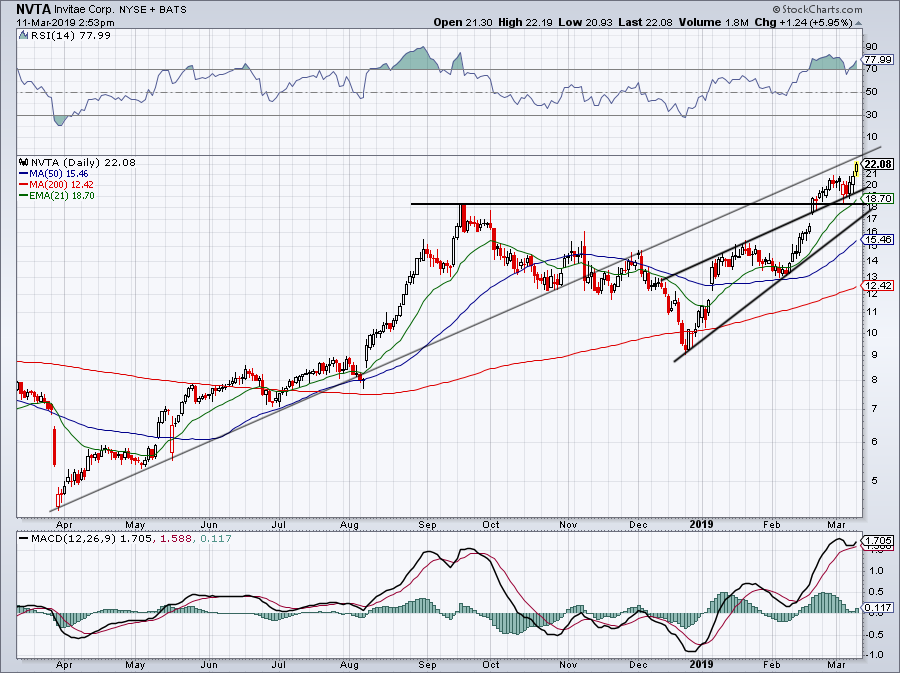
InVitae (NASDAQ:NVTA) has been such a beast since we flagged its breakout near $15. After tagging $21, the company announced a secondary, which temporarily weighed on the stock. However, investors gobbled up every last share (and then some) and this name is back to hitting new highs.

Nearly all of its trends (long term and short term) are from the lower left to the upper right, making this a prime buy-the-dips candidate. Look for a dip into recent uptrend support, with the 21-day trailing just behind. Keep in mind this name is overbought, but it’s got strong momentum in its sails.


Compare Brokers
Top Stock Trades for Tomorrow #5: Boeing

top stock trades for BAtop stock trades for BA

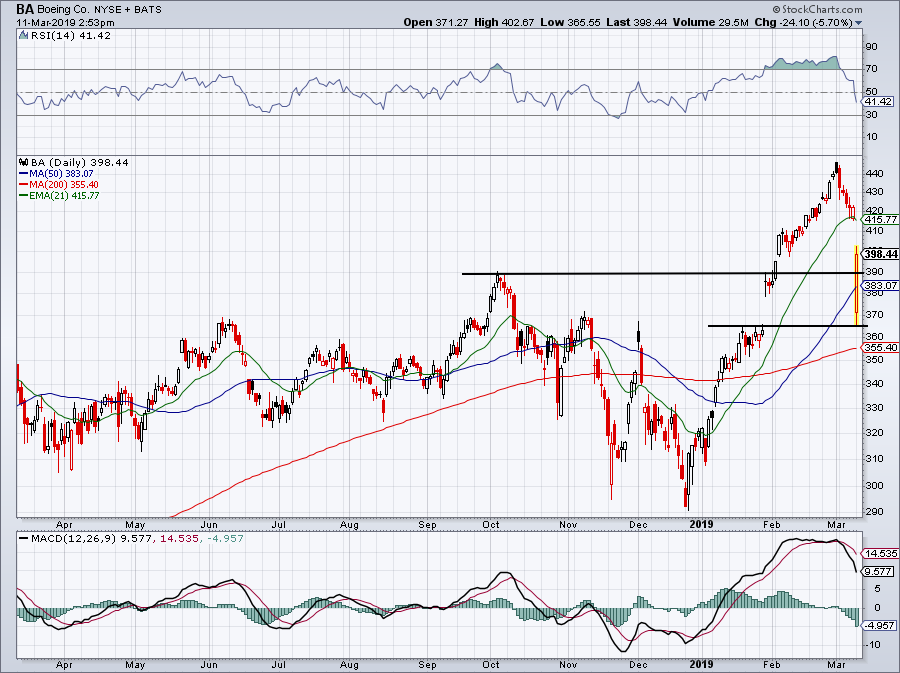
Bouncing hard off its lows, Boeing (NYSE:BA) stock suffered a nasty gap down from news of a fatal crash over the weekend. Shares were lower by more than 11% in early trading, but the stock has erased most of those losses.

After filling its January gap, BA promptly rallied through its 50-day moving average and $390. A close over $400 would be most ideal. Short-term bulls who bought the morning lows may consider taking profits, but at the very minimum, we want to see this one stay north of $390 and the 50-day. Below the latter and BA could revisit Monday’s lows.

Bret Kenwell is the manager and author of Future Blue Chips and is on Twitter @BretKenwell. As of this writing, Bret Kenwell is long NVDA, AAPL,

Tuesday, March 12, 2019

Burlington Stores Stumbles -- and It's a Buying Opportunity

Off-price retailer Burlington Stores (NYSE:BURL) has posted strong sales growth and steady margin expansion over the past several years. As a result, Burlington Stores stock soared more than 500% from less than $30 five years ago to an all-time high near $180 last fall. This far exceeded the share price gains delivered by its larger peers, TJX Companies (NYSE:TJX) and Ross Stores (NASDAQ:ROST).

However, Burlington finally experienced a setback last quarter when the company missed its sales guidance. That caused Burlington Stores stock to crash -- even though the company still beat its earnings guidance. This stock pullback looks like a buying opportunity for long-term investors.

Mixed results in the fourth quarter

In recent weeks, TJX and Ross Stores reported strong sales results for the fourth quarter. Ross Stores delivered 4% comp sales growth, while TJX achieved a particularly impressive 6% comp sales gain.

Unfortunately, Burlington wasn't able to match those strong performances. Comp sales rose just 1.3% during the fourth quarter, missing management's forecast for a 2% to 3% increase. Total sales did rise 7.4%, adjusting for the extra week in the fourth quarter of fiscal 2017, thanks to Burlington's aggressive pace of new store openings.

Management attributed the sales miss to several factors. First, the company faced a tough year-over-year comparison, as comp sales surged 5.9% in the prior-year period. Second, Burlington entered the fall season with inadequate inventory of cold-weather items and therefore missed out on sales in November. By the time it corrected this error -- in mid-December -- temperatures had risen, dampening demand. Third, the company has been struggling to improve its execution in the important ladies apparel market.

The exterior of a Burlington store

Burlington's comp sales growth slowed last quarter. Image source: Burlington Stores.

Despite its subpar sales growth, Burlington beat its forecast for earnings per share (albeit partly due to a lower-than-expected tax rate). Adjusted EPS surged 28% to $2.83 for the quarter. For fiscal 2018 overall, adjusted EPS reached $6.44: up 46% year over year. That far exceeded its initial full-year EPS guidance range of $5.73 to $5.83.

Ample room for sales growth and margin expansion

During fiscal 2018, Burlington opened 68 new stores and closed or relocated 22 locations. That drove a 7.3% increase in its store count to 675 locations. Management sees ample room to grow the chain to at least 1,000 stores over time. Given that Ross Dress for Less and T.J. Maxx have more than that number of stores in the U.S. and are still growing, this target seems conservative.

In fiscal 2019, Burlington will continue expanding aggressively, taking advantage of the ample real estate available following big-box store closures by the likes of Toys R Us. The company's plan calls for opening 75 new stores, offset by 25 store closures or relocations.

Burlington also aims to boost sales per square foot by reducing the average size of its stores and by gaining market share in the home and ladies apparel markets, where it is underpenetrated. It also has a substantial opportunity to grow in the toys and baby categories following the liquidation of Toys R Us and Babies R Us.

Meanwhile, by steadily reducing its inventory per store to boost inventory turnover, Burlington has expanded its operating margin by more than 4 percentage points over the past six years. Last year, the company's adjusted operating margin reached 9%, up from 8.5% a year earlier. TJX and Ross Stores both routinely earn double-digit operating margins, so there's clearly further room for improvement.

Burlington Stores stock is cheap enough to buy

While Burlington Stores doesn't have the same long track record of success as TJX and Ross Stores, it is following a similar playbook. Furthermore, there are ample signs that its strategy is working, as sales and profitability have surged since 2013.

For investors, the advantage of investing in Burlington Stores is that it has more room for sales growth and margin expansion than its larger rivals. Indeed, management expects adjusted EPS to reach a range of $6.93 to $7.06 this year, representing underlying growth of 10% to 12% year over year, excluding one-time items. And of course, it's important to remember that Burlington's earnings soared well beyond the company's initial forecast last year.

Burlington Stores stock has generally traded at a premium valuation in recent years because of its superior earnings growth. However, the stock now sits about 20% below its 52-week high and trades for just a little more than 20 times forward earnings. That's roughly in line with the valuations of TJX and Ross Stores. At this price, Burlington Stores looks like a great stock for patient investors.

Monday, March 11, 2019

Photon (PHO) Trading 39.8% Higher Over Last Week

Photon (CURRENCY:PHO) traded 0.4% higher against the US dollar during the 1-day period ending at 23:00 PM E.T. on March 8th. Photon has a total market capitalization of $312,265.00 and $3.00 worth of Photon was traded on exchanges in the last 24 hours. One Photon coin can currently be purchased for $0.0000 or 0.00000000 BTC on major exchanges including Cryptopia and C-Patex. During the last seven days, Photon has traded 39.8% higher against the US dollar.

Here’s how other cryptocurrencies have performed during the last 24 hours:

Get Photon alerts: Bitcoin (BTC) traded down 0.4% against the dollar and now trades at $3,902.41 or 1.00000000 BTC. Ethereum (ETH) traded down 1.6% against the dollar and now trades at $135.47 or 0.03474600 BTC. Litecoin (LTC) traded up 1% against the dollar and now trades at $57.33 or 0.01470385 BTC. Bitcoin Cash (BCH) traded down 1.5% against the dollar and now trades at $128.38 or 0.03292695 BTC. Monero (XMR) traded 1.1% lower against the dollar and now trades at $50.40 or 0.01292618 BTC. Ethereum Classic (ETC) traded 3.4% lower against the dollar and now trades at $4.25 or 0.00108923 BTC. Zcash (ZEC) traded 1.6% lower against the dollar and now trades at $49.72 or 0.01275226 BTC. Dogecoin (DOGE) traded down 0.5% against the dollar and now trades at $0.0020 or 0.00000051 BTC. Bitcoin Gold (BTG) traded 0.7% higher against the dollar and now trades at $12.59 or 0.00322888 BTC. DigiByte (DGB) traded 1% higher against the dollar and now trades at $0.0119 or 0.00000305 BTC.

About Photon

Photon is a proof-of-work (PoW) coin that uses the BLAKE256 hashing algorithm. It launched on February 21st, 2016. Photon’s total supply is 27,383,218,011 coins. The official website for Photon is www.photoncc.com. Photon’s official Twitter account is @PhotonCoin.

Photon Coin Trading

Photon can be bought or sold on the following cryptocurrency exchanges: C-Patex and Cryptopia. It is usually not possible to purchase alternative cryptocurrencies such as Photon directly using US dollars. Investors seeking to acquire Photon should first purchase Ethereum or Bitcoin using an exchange that deals in US dollars such as Gemini, Changelly or GDAX. Investors can then use their newly-acquired Ethereum or Bitcoin to purchase Photon using one of the exchanges listed above.

Sunday, March 10, 2019

National Beverage's Profitability Drops on Reduced Sales Volume

Investors were feeling nervous heading into National Beverage's (NASDAQ:FIZZ) fiscal third quarter earnings report this week. The soda and sparkling water specialist's management team claimed in its last announcement that sales trends had returned to normal at the start of the quarter, following a sharp deceleration in the previous three months.

In its actual results announced this week, the company revealed a further slowing of demand that suggests it is still struggling to reconnect with health-conscious sparkling water fans.

Let's take a closer look.

The raw numbers

 Metric

Q3 2019

Q3 2018

Year-Over-Year Gain (Decline)

Revenue

$221 million

$227 million

(3%)

Net income

$25 million

$41 million

(40%)

EPS

$0.53

$0.88

(40%)

Data source: National Beverage's financial filings. Chart by author.

What happened this quarter?

Sales trends fell into negative territory last quarter as news coverage surrounding the marketing of the LaCroix sparkling water brand continued to hurt demand. National Beverage also had trouble passing along higher costs, which amplified the negative profit impact from its sales volume declines.

A woman drinks sparkling water from a glass.

Image source: Getty Images.

Here are the key highlights of the quarter. 

Sales declined 3% compared with a 7% increase last quarter and a 13% spike in the fiscal first quarter. Revenue gains have slowed to 8% over the past 12 months, versus 18% in fiscal 2018. Volume decreased 4% year over year, which was partly offset by higher average selling prices. Gross profit margin fell to 36.5% of sales from 40.1% a year earlier due to the falling sales volumes. In addition, manufacturing costs jumped 10% per case sold, compared with a 3.7% increase in prices. The company spent more on marketing and distribution, which helped push expenses up to 22.4% of sales from 20% a year earlier. When combined with the lower gross profit, this shift reduced pre-tax income to $32 million, or 14.6% of sales, from $46 million, or 20.3% of sales in the prior-year period. Higher tax expenses contributed to a 40% decline in net income. What management had to say

CEO Nick Caporella's comments didn't deviate from his characteristically animated style. "We are truly sorry for these results," Caporella said in a press release. "Negligence nor mismanagement nor woeful acts of God were not the reasons," he explained, but instead "much of this was the result of injustice!" Management added more detail in the 10-Q filing, stating that the volume declines were "principally due to widespread media coverage of litigation regarding the marketing and labeling of LaCroix."

Caporella sought to reassure investors by saying that the LaCroix brand was in no danger of taking on lasting damage. "Nothing herein mentioned has detracted from the ultimate value and future of our dynamic company," he said.

Looking forward

These results demonstrate that National Beverage hasn't moved past the branding hit that began to hurt results in the fiscal second quarter. The company could continue to struggle over the coming quarters, especially as it seeks to absorb rising costs in the context of weak sales volumes.

An even bigger concern for investors, and a likely driver of the stock's sharp decline following the results, may be the spotty track record that management has established through this demand challenge. Its early-December prediction of a return to normal growth patterns didn't pan out this quarter, so investors see more reasons to be cautious about the business. Thus, in addition to stabilizing sales, Caporella and his team have to work at regaining investor confidence.